A Day Without Meds is like a Day Without…

“Friendship is a wildly underrated medication” – Anna Deavare Smith

I started taking Levodopa five years ago immediately following diagnosis. Right from the start, I didn’t notice a significant impact. Other PWP spoke about their on/off times and how they watch the clock in anticipation of their next dose and intended relief. I have never felt that way – in fact, if I didn’t have a reminder set on my phone, I might likely forget to take my meds! I’ve mentioned this to my neurologist, but she felt that the meds were having an impact and that my low dose was beneficial.

I have often toyed with the thought of going off them just to see how they work or don’t work, but have never followed through with my curiosity.

Well, purely by accident, this curiosity was unfortunately answered.

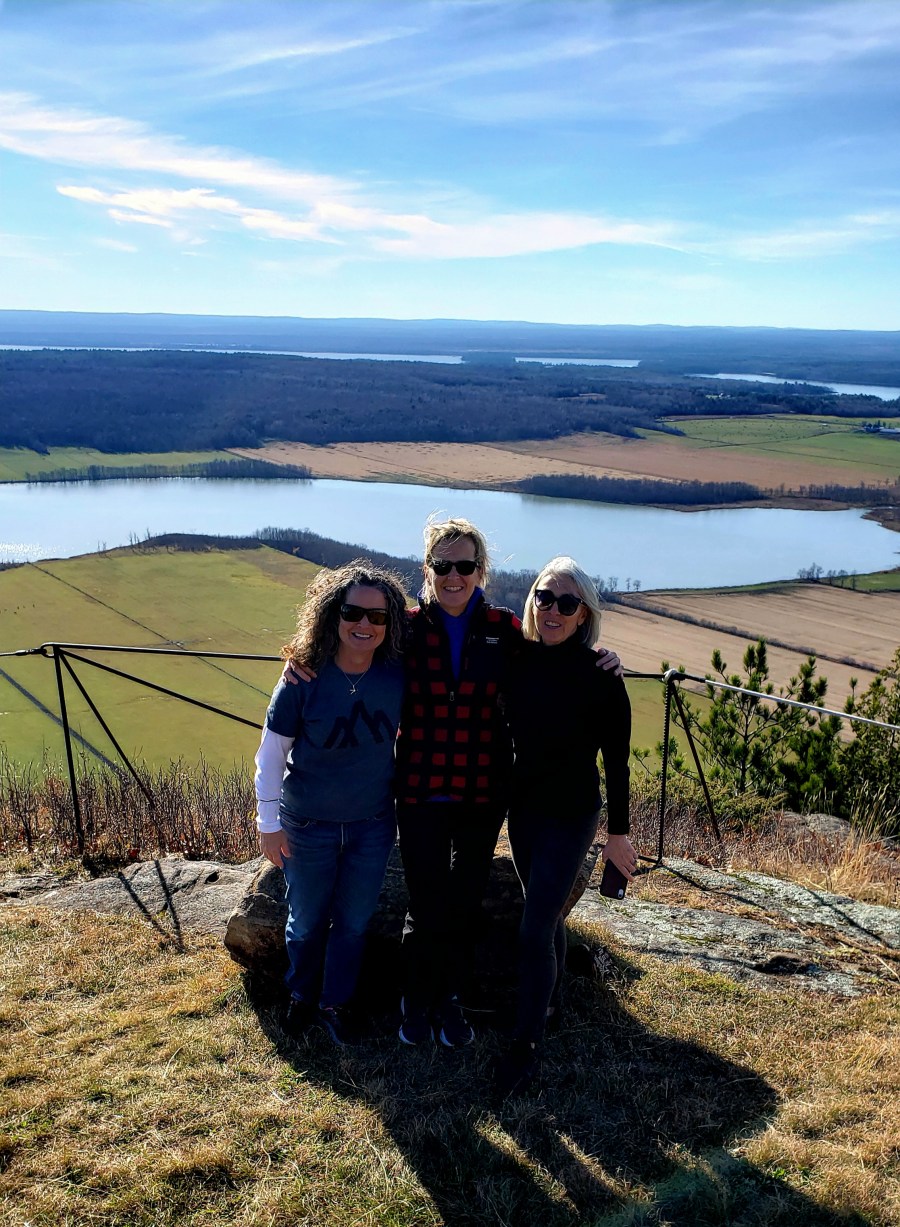
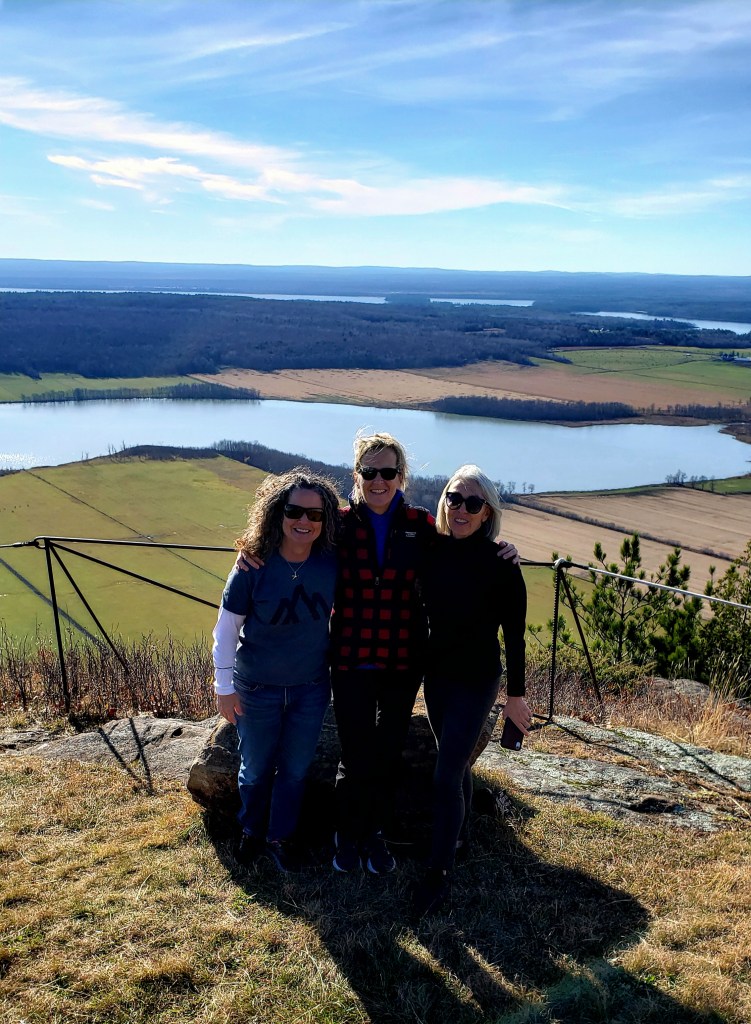
I went away for a weekend with the best-ever lifelong friends and when I looked to take my 8pm dose, I was alarmed to realize that I had forgotten my pill pack. Oh my! I kept this information to myself. I knew this wasn’t life-threatening and I also didn’t want to alarm my friends. The meds were a two-hour drive away and I didn’t want to upset the weekend.

All remained relatively ‘normal’ for the first 24 hours. Time was spent hiking outdoors in the sunshine with two of my favourite people. Laughter, sunshine, and exercise are all producers of natural dopamine which is what I will credit for the initial feeling of normalcy. Without these, I predict I would have felt the ‘off’ period much sooner. But after a full day unmedicated, all hell broke loose.

I did not sleep…all night long. My left side was tremoring just enough to wreak havoc on my ability to calm. By morning, my body was crying for dopamine. I was emotional, stressed, and physically and mentally exhausted.

Upon arriving home, I took my meds and within 30 minutes, calm was restored.

Did I survive? Yes

Did I have fun? Absolutely

Do I need medication? 100%

Now I know.
Plateau

“Almost everything will work again if you unplug it for a few minutes…including you.” -Anne Lamott

Over three months ago, I wrote Waves which described my desire to take a break from all things Parkinson’s related. And much to my own surprise, I am not yet ready to return to advocacy, research, or fundraising.

This is not apathy.

This is not negativity.

This is living.

Summer was warm, relaxed, and filled with great times spent with family, friends, and plenty of days at the beach. (*note: the beach fixes everything!)

Yes, there are moments when symptoms can take some of the joy out of my day and interfere with my plans. But I have a toolkit of strategies that usually enable me to get through those times.

I believe I am currently hovering in a welcome state of ‘plateau’ where disease progression has paused somewhat.

OR… perhaps because my focus has shifted away from PD, I simply haven’t felt/noticed progression.

Either way, I am happy to remain atop this plateau for a while longer.

Waves

But I think that I have already been moving too long in a sphere which is not my own – allow me to paddle in my own element.– Ivan Turgenev

I held off on posting this for a few days as I feared that it might come off as too negative. But I want this blog to be authentic so here you go…

I’m learning that living alongside a chronic neurodegenerative illness like Parkinson’s Disease might possibly be similar to navigating a wavy ocean. Or in my case, since I don’t live near the ocean, steering a canoe through both fair and stormy weather. Sometimes when the water is rough, you rely on your experience and employ all of your paddling skills to safely make it through the storm. Other times, the waters are smooth and you can take in the scenery as you mindlessly dip your paddle in to move forward.

This is where I want to be. Even though, at times, the conditions may be rough…I want to purposely choose smooth.

Mindless dipping sounds good.

I am taking a break from reading through and deciphering the complicated language and purpose of ‘promising’ scientific research reports. If they find a cure, I’ll surely hear about it.

I am taking a break from advocating and building awareness for Parkinson’s Disease. Releasing myself from the ‘patient pressure’ to inform others.

I am taking a break from trying to read through Parkinson-based books on my bedside table. Fictional escapism will produce better dreams.

I am taking a break from trying all of the latest recommended supplements and dietary changes. I am going to eat the cake.

I am taking a break from Parkinson’s.

Of course, Parkinson’s never takes a break from me, but I can dictate how much I give back to it.

While I am sure I will likely get back on board at some time in the future, for today I’m riding the perfect wve.


My New Ride

Modify. Adapt. Adjust. Shift gears…

While I really have a strong dislike for the words I can’t, I have come to realize that there are certain things that I shouldn’t do.

Riding my bicycle is one of those things. I have some left-side balance issues, left-side shoulder stiffness, weakness, and pain, and a new diagnosis of Osteoporosis (that’ll be another post!). So cycling just doesn’t seem like a safe thing for me to do. The risk of falling seems too great.

Could I? Yes.

Should I? Probably not…for now.

But my Parkinson’s brain has a distinct need for high-intensity interval exercise (read more here: Parkinson News today Oct. 2019).

So I need to modify. Adapt. Adjust. Shift gears…

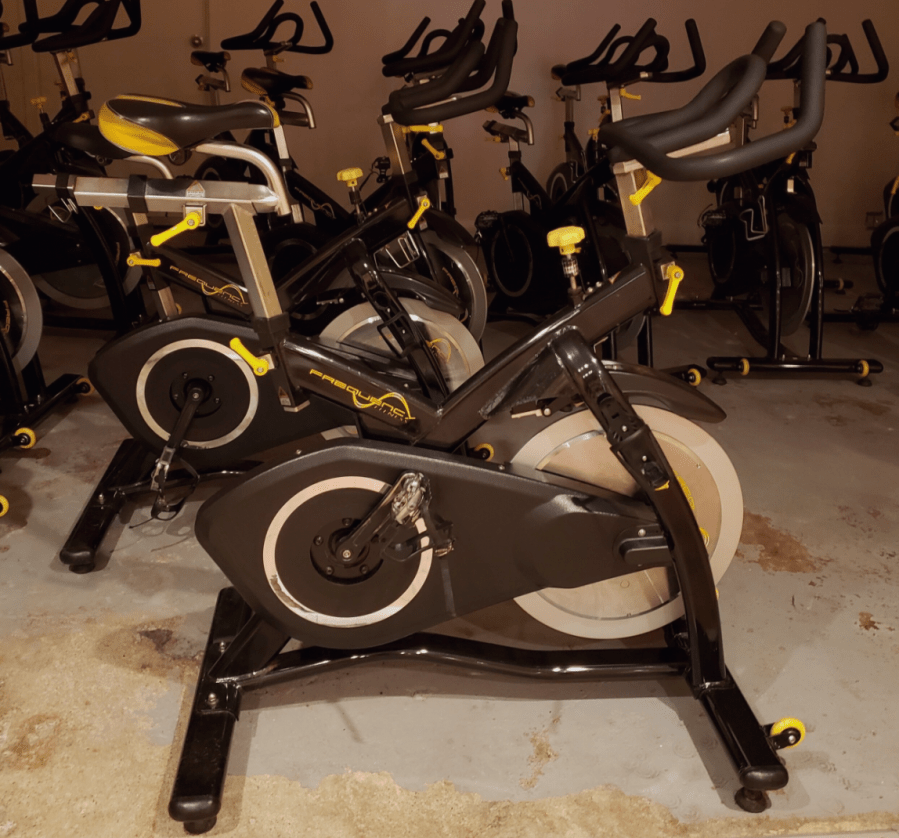
I found a Ride class at my Yoga Studio and I am loving it!

Ride: This indoor cycle class is a safe, sweaty place to elevate your cardiovascular fitness or simply put a fun spin on your cross-training! By adjusting the bike gears throughout the class to your specific needs, this class is accessible at any time. From gentle to powerful, get on the bike and ride! (BlissAnn Green Yoga).

While I would still prefer to be riding outside, this workout provides me with a much safer alternative and a social outlet as well.

Now…I just need to find a place where I can safely alpine ski!!

Stop and See the Roses

Losing my sense of smell was my first symptom of PD, although I didn’t know it!

Looking back, years before there was any sign of a tremor, I recall noticing that I was losing my ability to smell. It certainly didn’t happen overnight, but every now and then, someone would say;

“Ewww what’s that smell?” or “Mmmm that smells good.”

And I would try to smell…and there would just be nothing?

I never thought anything of it. Now I know that it is one of the most common early symptoms among many people with Parkinson’s Disease.

It’s called Hyposmia (lessened sensitivity to odors) and it usually appears a few years before other symptoms. There is no treatment for it. And because smell is so closely connected to taste, it can affect your diet and lead to weight loss which could be problematic.

But when it comes to bad smells… I am so lucky!

When the odor of a skunk filters through the yard; I am so lucky!

When someone passes by me smoking a cigarette; I am so lucky!

When someone passes gas (I won’t name names); I am so lucky!

Let’s face it – there are a lot of unpleasant odours out there that I certainly don’t miss!

The only time I truly miss it is when someone points out how wonderful something smells and I realize I can’t experience the same feeling of joy. Flowers, puppy breath, fresh baked cookies, the salty air at the beach, a pine tree, a campfire, babies, etc.

But the brain is a wonderful thing and I believe that every now and then, my eyes fill in the gaps for my nose. My eyes have created ‘smell’ memories and when I see lilacs or roses, I can somehow retrieve the memory of how beautiful they smell. Doesn’t happen all the time, but when it does I enjoy it!

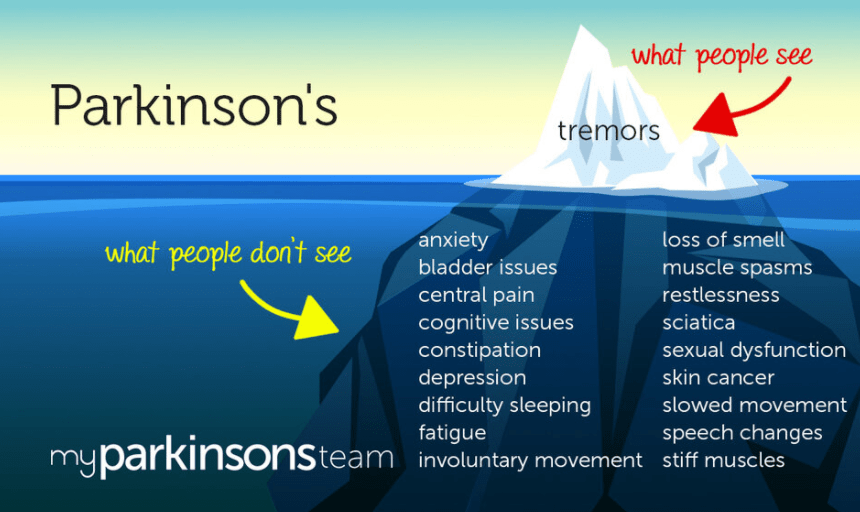
The Tip of the Iceberg

“What we see often is only a fractional part of what really is” – Unknown

Parkinson’s Disease = Tremor.

Having a tremor is what most people think of when they hear about Parkinson’s Disease. I know I did.

It is the most visible of all symptoms but certainly not the worst symptom. There is so much more going on beneath the surface which makes PD very complex.

They say that if you know a person with PD, then you know one person with PD. No two are alike. Symptoms vary from person to person. But what we all share is that we are not just what you see on the outside.

Do I experience all of the symptoms that are on the infographic?

Thankfully, no.

Not yet.

Levodopa vs. Protein

The great race to the brain. Timing your meds is very important!

The greatest thing about Levodopa is that it gets along very well with other meds. The worst thing about Levodopa is that it does not play well with protein. These two compete with one another in a vigorous race through the bloodstream to get to the brain…and Levodopa always loses. Once food and pills go into the digestive tract, protein (amino acids) are often the first in line to be absorbed which means less medication gets through.

So they need to be separated in order for levodopa to be effective.

Levodopa needs a solid 30-minute headstart to win the race (take meds 30 minutes before meals involving protein) or wait to take meds 2 hours after a meal when the lineup in the digestive tract has dispersed).

Many people take multiple levodopa pills throughout the day to get some symptom relief (I take 3). So this protein interaction can become a little complicated but it is really important to make a plan for optimal absorption.

I have a timer set on my phone to remind me to take my pills and this is set for 30 minutes prior to mealtime.
For more info click the link here: Levodopa and Protein Medication Absorption

Embrace the Shake!

Learning to accept my limitations has increased my freedom!

At the first sight of a slight tremor in my left pinky finger, I was fascinated. I would often show people like it was something funny! Sort of like tricks that you could do when you were a kid (ie. touching your tongue to your nose) and saying, ‘Look what I can do!”

When that tremor slowly spread its way through my fingers and up my arm, it quickly became something that I tried desperately to hide. If I was making a presentation, I would hold that arm behind my back. If I was in a meeting, I would sit on that hand to cover it up. I would often clasp my hands together and dig my thumb into the palm of my left hand to try to gain some control as though causing pain would trick my brain into sending a different response. Trying to hide the tremor became harder. And it seemed the more I was aware of it, the harder it was to control.

For those of you without a tremor, it can be hard to understand. But if you’ve ever participated in a sport that required you to hold a position (ie. weight lifting, yoga, rock-climbing etc.) then you might have experienced a tremor-like feeling. When rock climbing, we called it ‘sewing machine leg’ – your leg would shake involuntarily when you were trying to reach for your next hold.

Recently I started doing Spin classes (group cycling classes on stationary bicycles). This is a great workout for me as it is high intensity, with no risk of falling off the bike! During my last class, we were climbing up a steady hill and working hard. The instructor shouted out at us to ‘embrace the shake’ in our leg muscles as the climb got slower and more difficult.

I smiled.

Great advice.

Trying to hide something that can’t be hidden is useless.

Embrace the shake.

Ted Talk: Embrace the Shake

Withdrawal

“As much as you can in your life, say YES.” Mary Carillo

A friend texted me to get together for coffee this morning.  I read the message and instantly cringed and said ‘no’ out loud. Not today, I thought. I replied to her that today didn’t work, but Wednesday would be a good day. Yes, Wednesday. We could go snowshoeing. Yes, this is a great idea…everything will be better on Wednesday…until Wednesday rolls around and I will still not want to go.

Don’t get me wrong, I love seeing my friends and when I’m with them they make me happy. But something has changed lately with my ability/desire to put myself out there.

I consider this behaviour to be my latest developing symptom/side effect of Parkinson’s Disease. I’m not really sure what to call it; but I know that it is real and it is progressing just like my other PD symptoms.

Let’s call it withdrawal.

More and more I find myself wanting to withdraw from social situations, events, and commitments. This is an unusual mindset for me as I used to enjoy having a schedule filled with gatherings both large and small. However, this past holiday season, I found myself opting to stay in more often. Refusing rather than accepting invitations became the norm.

And my reasons for withdrawal are not so easily defined. Perhaps there is a neurological connection or a dopamine issue that contributes to withdrawal in people with Parkinson’s but I will leave that discussion to the medical professionals.

I believe this is a ‘me-thing.’ Therefore I have to look inward to get at the root of my withdrawal.  

Have I become increasingly aware of people watching me?

Am I concerned that people think I’ve had too much to drink because of changes to my gait and my speech?

Am I stressed at trying not to shake, not to slur my words, not to lose my balance, not to appear stiff, and to purposefully make my face smile?

Is it becoming increasingly difficult to pretend that I’m ok?

Yes.

Withdrawing and staying home is so much less complicated and significantly more comfortable than going out.

If withdrawal is a side effect of Parkinson’s Disease, then I need to treat it as such. There are so many things that I do to manage my physical symptoms and if I fail to treat any of my symptoms, I don’t feel well.

Likewise, if I fail to address this withdrawal, I won’t feel well either. Abandoning my social activities could lead to loneliness, isolation, and depression. These are also very common side-effects of Parkinson’s disease that I do not wish to experience.

What can I do to treat withdrawal?

Go snowshoeing on Wednesday!

**Update: I went snowshoeing on Wednesday and it was wonderful!


Adjustment Disorder

“She stood in the storm and when the wind did not blow her away, she adjusted her sails.” Elizabeth Edwards

A few months after I was diagnosed with Parkinson’s, I crashed…completely. Initially, I had taken the news rather well and felt that nothing had changed. I went about my life and my job as though I could still do it all. It was ‘all good.’

My body said otherwise.

By the time I decided it was time to see the doctor, I was physically, mentally, and emotionally exhausted. My bloodwork was crazy. Anemia, low blood pressure, irregular heartbeat, etc. made the simplest of tasks seem exhausting. I was not coping well physically or emotionally.

My doctor called it ‘Adjustment Disorder.’  This made perfect sense. It could be called Acceptance Disorder, Acknowledgement Disorder, Adherence Disorder etc. Nevertheless, I wasn’t doing well at any of those things. I had developed a chronic, neurodegenerative disease for which there is no cure and no treatment to slow the progression. Yet, I expected my life to continue as though everything was normal. (As I mentioned in The Telling, I tried to downplay and make light of PD…not the best idea!)

My doctor put me on a medical leave of absence from work. I used this time to adjust. Not easy. Eventually, I practiced some much-needed self-care and I began to gather my team of professionals to help me deal with the many facets of this disease.

It took time, four months to be exact, to build my system back up to working order, and even then I was only able to return to work for half days.

I think I will always have Adjustment Disorder.  But I think I have learned to listen to my body and recognize when I need to give myself a break.

To learn more about Adjustment Disorder, click here: Mayo Clinic Adjustment Disorder

Okay.

“Diagnosis is not the end, but the beginning of practice.” Martin Fisher

May 5, 2017: Diagnosis Day.

I had an appointment with my neurologist before heading to work. I had been seeing her for just over two years because I was having some weird things going on in my body and I needed answers. At that time, my symptoms included; tremors in my left hand, stiffness, rigidity, shoulder/arm pain, swallowing difficulty, mild speech issues, trouble sleeping, small illegible handwriting, and loss of smell. And if you google Parkinson’s symptoms…like I did…this is what comes up; Ten Early Warning Signs of Parkinson’s Disease

I scored a solid 7/10 on a test that I would have preferred to fail.

At my first appointment in 2015, she said,

“I can tell by looking at you that you don’t have Parkinson’s.”

Phew! Everything that I had read and researched pointed a very straight arrow at Parkinson’s but she was the neurologist…she would know for sure right? Regardless, we still needed to figure out what was going on with me.

And so began a number of other tests, MRIs, X-rays, CT scans, ultrasounds, and nerve conduction tests. We ruled out MS, brain tumors, and spinal tumors. And we confirmed arthritis in my neck and a small tear in my rotator cuff.

Two years later, on that beautiful sunny May morning, I sat in her office listening to her change her mind, “Well, I think I can say that you have Parkinson’s Disease. You are 49 so technically you have Young Onset Parkinson’s Disease or YOPD.”

She talked about starting me on the lowest dose of Sinemet (carbidopa/levodopa).

I said, “okay.”

She said, “You won’t die from it. You’ll die with it.”

I said, “okay.”

She said she would see me in 3 months.

I said, “okay.”

I left and called my husband Garth.

We said, “okay.”

Neither one of us was truly surprised, maybe even somewhat relieved to finally be able to put a name to these problems. However, it still hit hard when I heard those confirming words. If I went home I would have cried the day away, so I went to work.

I put on a pretend happy face, and I didn’t tell anyone else for over two weeks. 

I couldn’t.

I dreaded the thought of people feeling sorry for me.

I still do.

https://pixabay.com/users/johnhain-352999/