Embrace the Shake!

Learning to accept my limitations has increased my freedom!

At the first sight of a slight tremor in my left pinky finger, I was fascinated. I would often show people like it was something funny! Sort of like tricks that you could do when you were a kid (ie. touching your tongue to your nose) and saying, ‘Look what I can do!”

When that tremor slowly spread its way through my fingers and up my arm, it quickly became something that I tried desperately to hide. If I was making a presentation, I would hold that arm behind my back. If I was in a meeting, I would sit on that hand to cover it up. I would often clasp my hands together and dig my thumb into the palm of my left hand to try to gain some control as though causing pain would trick my brain into sending a different response. Trying to hide the tremor became harder. And it seemed the more I was aware of it, the harder it was to control.

For those of you without a tremor, it can be hard to understand. But if you’ve ever participated in a sport that required you to hold a position (ie. weight lifting, yoga, rock-climbing etc.) then you might have experienced a tremor-like feeling. When rock climbing, we called it ‘sewing machine leg’ – your leg would shake involuntarily when you were trying to reach for your next hold.

Recently I started doing Spin classes (group cycling classes on stationary bicycles). This is a great workout for me as it is high intensity, with no risk of falling off the bike! During my last class, we were climbing up a steady hill and working hard. The instructor shouted out at us to ‘embrace the shake’ in our leg muscles as the climb got slower and more difficult.

I smiled.

Great advice.

Trying to hide something that can’t be hidden is useless.

Embrace the shake.
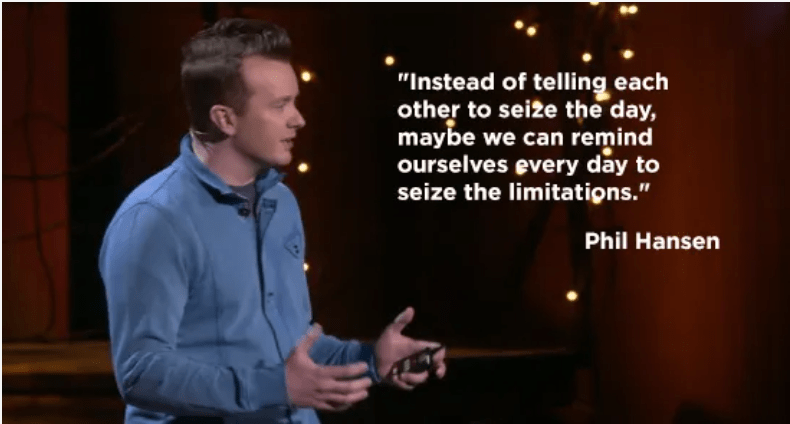
Ted Talk: Embrace the Shake

Withdrawal

“As much as you can in your life, say YES.” Mary Carillo

A friend texted me to get together for coffee this morning.  I read the message and instantly cringed and said ‘no’ out loud. Not today, I thought. I replied to her that today didn’t work, but Wednesday would be a good day. Yes, Wednesday. We could go snowshoeing. Yes, this is a great idea
everything will be better on Wednesday
until Wednesday rolls around and I will still not want to go.

Don’t get me wrong, I love seeing my friends and when I’m with them they make me happy. But something has changed lately with my ability/desire to put myself out there.

I consider this behaviour to be my latest developing symptom/side effect of Parkinson’s Disease. I’m not really sure what to call it; but I know that it is real and it is progressing just like my other PD symptoms.

Let’s call it withdrawal.

More and more I find myself wanting to withdraw from social situations, events, and commitments. This is an unusual mindset for me as I used to enjoy having a schedule filled with gatherings both large and small. However, this past holiday season, I found myself opting to stay in more often. Refusing rather than accepting invitations became the norm.

And my reasons for withdrawal are not so easily defined. Perhaps there is a neurological connection or a dopamine issue that contributes to withdrawal in people with Parkinson’s but I will leave that discussion to the medical professionals.

I believe this is a ‘me-thing.’ Therefore I have to look inward to get at the root of my withdrawal.  

Have I become increasingly aware of people watching me?

Am I concerned that people think I’ve had too much to drink because of changes to my gait and my speech?

Am I stressed at trying not to shake, not to slur my words, not to lose my balance, not to appear stiff, and to purposefully make my face smile?

Is it becoming increasingly difficult to pretend that I’m ok?

Yes.

Withdrawing and staying home is so much less complicated and significantly more comfortable than going out.

If withdrawal is a side effect of Parkinson’s Disease, then I need to treat it as such. There are so many things that I do to manage my physical symptoms and if I fail to treat any of my symptoms, I don’t feel well.

Likewise, if I fail to address this withdrawal, I won’t feel well either. Abandoning my social activities could lead to loneliness, isolation, and depression. These are also very common side-effects of Parkinson’s disease that I do not wish to experience.

What can I do to treat withdrawal?

Go snowshoeing on Wednesday!

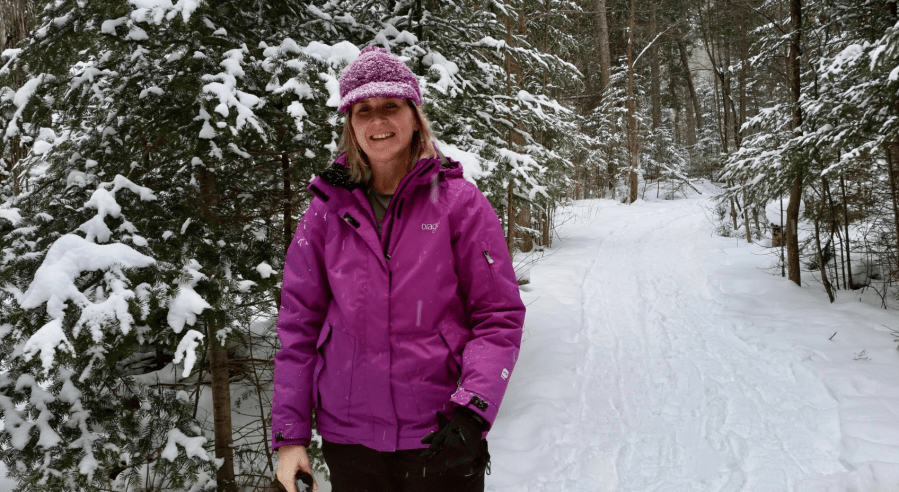
**Update: I went snowshoeing on Wednesday and it was wonderful!


I am so Lucky!

“Remember that sometimes not getting what you want is a wonderful stroke of luck” Dalai Lama.

After a four-month leave from my job to deal with ‘Adjustment Disorder,’ I returned to work in a modified position. Instead of being a Vice Principal in a very busy high-needs school, I was assigned to work at the School Board office as an assistant to one of the Superintendents. This job was mostly administrative in nature. I had an office to myself and I worked on my own. This was the complete opposite of what I was used to; a bustling office filled with students, parents, and staff all requiring my immediate attention.

After getting diagnosed, I knew that I would not be advancing my career to become a Principal. In fact, I wasn’t really sure what my future held in terms of my career, but I was happy just to be contributing.

While my fellow VPs were making advancement plans, I was not. This was challenging for me. It wasn’t part of my plan. I didn’t choose this.

Upon hearing that I was working at the Board Office among senior staff, one of those colleagues said, “You’re so lucky!” She felt that I would have an edge moving forward since I was now working among our superiors. I reminded her that I had PD and would no longer be pursuing the same career goals.

Perception is an incredible thing. She thought that I was lucky! At first, I couldn’t believe she felt I had any kind of good luck! I had a terrible disease and I was dealing with career loss!

But in time, I have learned that she was actually right!

I am so lucky!

Those four words have become a mantra for me and you will see them appear often throughout this blog.

Adjustment Disorder

“She stood in the storm and when the wind did not blow her away, she adjusted her sails.” Elizabeth Edwards

A few months after I was diagnosed with Parkinson’s, I crashed
completely. Initially, I had taken the news rather well and felt that nothing had changed. I went about my life and my job as though I could still do it all. It was ‘all good.’

My body said otherwise.

By the time I decided it was time to see the doctor, I was physically, mentally, and emotionally exhausted. My bloodwork was crazy. Anemia, low blood pressure, irregular heartbeat, etc. made the simplest of tasks seem exhausting. I was not coping well physically or emotionally.

My doctor called it ‘Adjustment Disorder.’  This made perfect sense. It could be called Acceptance Disorder, Acknowledgement Disorder, Adherence Disorder etc. Nevertheless, I wasn’t doing well at any of those things. I had developed a chronic, neurodegenerative disease for which there is no cure and no treatment to slow the progression. Yet, I expected my life to continue as though everything was normal. (As I mentioned in The Telling, I tried to downplay and make light of PD
not the best idea!)

My doctor put me on a medical leave of absence from work. I used this time to adjust. Not easy. Eventually, I practiced some much-needed self-care and I began to gather my team of professionals to help me deal with the many facets of this disease.

It took time, four months to be exact, to build my system back up to working order, and even then I was only able to return to work for half days.

I think I will always have Adjustment Disorder.  But I think I have learned to listen to my body and recognize when I need to give myself a break.

To learn more about Adjustment Disorder, click here: Mayo Clinic Adjustment Disorder

Team Carla

“Surround yourself with a care team that is dedicated to making your life better.” – Me

Before I told my children or my other family members, I told my physiotherapist and my osteopath that I had been officially diagnosed with Parkinson’s Disease. Some might find this strange, but these two professionals had been with me since the first signs of tremor, rigidity, and stiffness appeared.

It was also great to practice telling people who weren’t emotionally invested in my well-being!

Neither of them was shocked and both moved quickly to develop a treatment plan based on this new information. They provided me with optimism at a time when this was truly lacking. They are both the ‘rockstars’ in their field and I am incredibly grateful for their role in my life.

I laughingly told them that my expectations of them were extremely high and that I was confident they would fix this! They both continue to work hard to ease my pain, improve my movement, and bring calm to my tremors. And we laugh
a lot!

Team Carla has many members now. They are all critical pieces to the puzzle of my PD.

  • Physiotherapist
  • Osteopath
  • Chiropractor
  • Physiatrist
  • Counselor/Therapist
  • Massage Therapist
  • Naturopath
  • Neurologist
  • Family Doctor
  • Speech Therapist
  • Cardiologist
  • Movement Disorder Specialist
  • and of course my husband, Garth!

ADVICE: Assemble your own team as early as you can – you will manage so much better with support. And if you aren’t fully satisfied with a member, keep looking until you find that perfect fit.

For more info on building your own care team, visit the Michael J. Fox Foundation: Building a Care Team

The Telling

“The disease is yours. Sit with it for a bit. Take your time to share it with others as you see fit.” – Me

After talking to my kids, I eventually had to deal with the rest of the world. Ugh
 I struggled with how to do this? I knew one thing for sure;

I did not want anyone to feel sorry for me.

So I made a plan and this is what I came up with;

  1. I could/would not cry when I told people.
  2. I would put the most positive spin on it.
  3. I would downplay the effects that the disease was having upon me.
  4. I would tell them that this was ‘all good.’

Basically, I would make light of PD, as well as my feelings about it, in order to get me through ‘the telling.’

After a couple of weeks passed, I began.

My sisters, my parents, and some close friends were told face to face or by phonecall depending upon geography and distance. Receiving their caring reactions was incredibly difficult, but I stuck to my plan. Other friends got text messages – this was quick and painless as they had time to react privately and I had time to react privately to their kind words. Slowly I released the news to my employer and my colleagues – this was easier as they saw me daily and were aware of my symptoms.

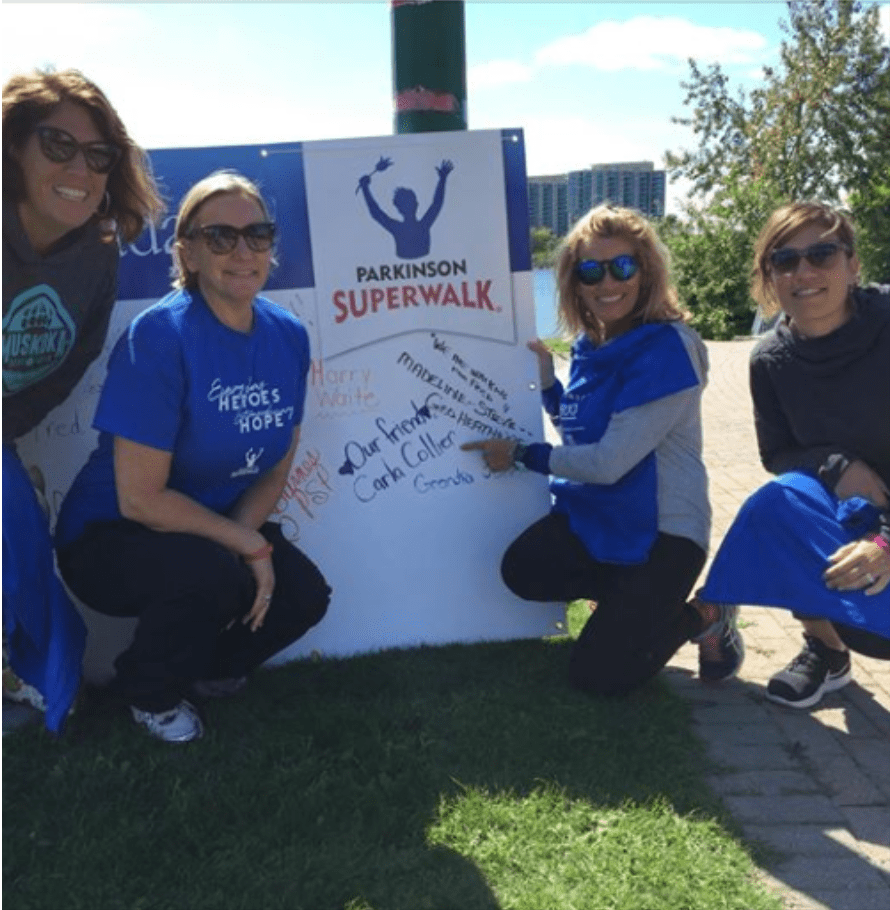
And the rest of my world, who hadn’t yet heard by word of mouth, found out in my ‘coming out’ post on Facebook 4 months after diagnosis. This occurred on the same day as the Parkinson’s Superwalk (Canadian annual fundraiser for PD). I had intended to participate but had to head out of town for our cousin’s funeral. Our cousin Brigid was taken far too soon after a valiant struggle with cancer. Her positive attitude toward life was clearly evident in the words spoken about her by her family and close friends. She lived her best life and helped so many others do the same.

The message conveyed at the funeral was that of gratitude.

While away, my dear friends at home participated in the Parkinson’s SuperWalk for me! I felt so much gratitude and I wanted to recognize them for the kind-hearted gesture that they had done on my behalf.

Seemed like the perfect opportunity to go public.

Can I Call You McFly?

“If you put your mind to it you can accomplish anything” Marty McFly

Sharing the diagnosis with my husband was easy as we had talked about the possibility on a daily basis for some time. But telling my kids? This was going to be challenging. They were teenagers. They knew something was up as they could see my symptoms developing but saying the words out loud was something I had to wrap my head around before I could carry it off without falling apart.

I very quickly dismissed the idea of telling them in the ‘family meeting’ format. I couldn’t face all of them at once without becoming emotional and I wanted each of them to have their own private reaction time.

They have very different personalities and would need to be told in three very different ways. The boys were understandably quiet and they had very few questions. I reassured them that I was totally fine and, that in my case, this was not hereditary as nobody else in the family history had PD.

I got through all three deliveries without crying and I was very proud of myself for appearing strong.

Oddly enough, at one point, I actually found myself laughing! You see the Back to the Future movie series had been a favourite at our house and the boys absolutely love Michael J. Fox (aka Marty McFly). So when I referenced how the MJFF (Michael J. Fox Foundation) is searching for a cure and that I felt they were getting close, one of the boys held both of my hands, looked into my eyes, and said,

“Can I call you McFly?”

Absolutely!

Telling your loved ones that you have a progressive neurological disease is indeed scary for you and for them. I would suggest you take some time to create some sort of plan so that you can be prepared for the message you want to give and the reactions you may receive.

Great information from the MJFF here; Sharing Your Diagnosis

and here; Taking to Children

Okay.

“Diagnosis is not the end, but the beginning of practice.” Martin Fisher

May 5, 2017: Diagnosis Day.

I had an appointment with my neurologist before heading to work. I had been seeing her for just over two years because I was having some weird things going on in my body and I needed answers. At that time, my symptoms included; tremors in my left hand, stiffness, rigidity, shoulder/arm pain, swallowing difficulty, mild speech issues, trouble sleeping, small illegible handwriting, and loss of smell. And if you google Parkinson’s symptoms
like I did
this is what comes up; Ten Early Warning Signs of Parkinson’s Disease

I scored a solid 7/10 on a test that I would have preferred to fail.

At my first appointment in 2015, she said,

“I can tell by looking at you that you don’t have Parkinson’s.”

Phew! Everything that I had read and researched pointed a very straight arrow at Parkinson’s but she was the neurologist
she would know for sure right? Regardless, we still needed to figure out what was going on with me.

And so began a number of other tests, MRIs, X-rays, CT scans, ultrasounds, and nerve conduction tests. We ruled out MS, brain tumors, and spinal tumors. And we confirmed arthritis in my neck and a small tear in my rotator cuff.

Two years later, on that beautiful sunny May morning, I sat in her office listening to her change her mind, “Well, I think I can say that you have Parkinson’s Disease. You are 49 so technically you have Young Onset Parkinson’s Disease or YOPD.”

She talked about starting me on the lowest dose of Sinemet (carbidopa/levodopa).

I said, “okay.”

She said, “You won’t die from it. You’ll die with it.”

I said, “okay.”

She said she would see me in 3 months.

I said, “okay.”

I left and called my husband Garth.

We said, “okay.”

Neither one of us was truly surprised, maybe even somewhat relieved to finally be able to put a name to these problems. However, it still hit hard when I heard those confirming words. If I went home I would have cried the day away, so I went to work.

I put on a pretend happy face, and I didn’t tell anyone else for over two weeks. 

I couldn’t.

I dreaded the thought of people feeling sorry for me.

I still do.

https://pixabay.com/users/johnhain-352999/